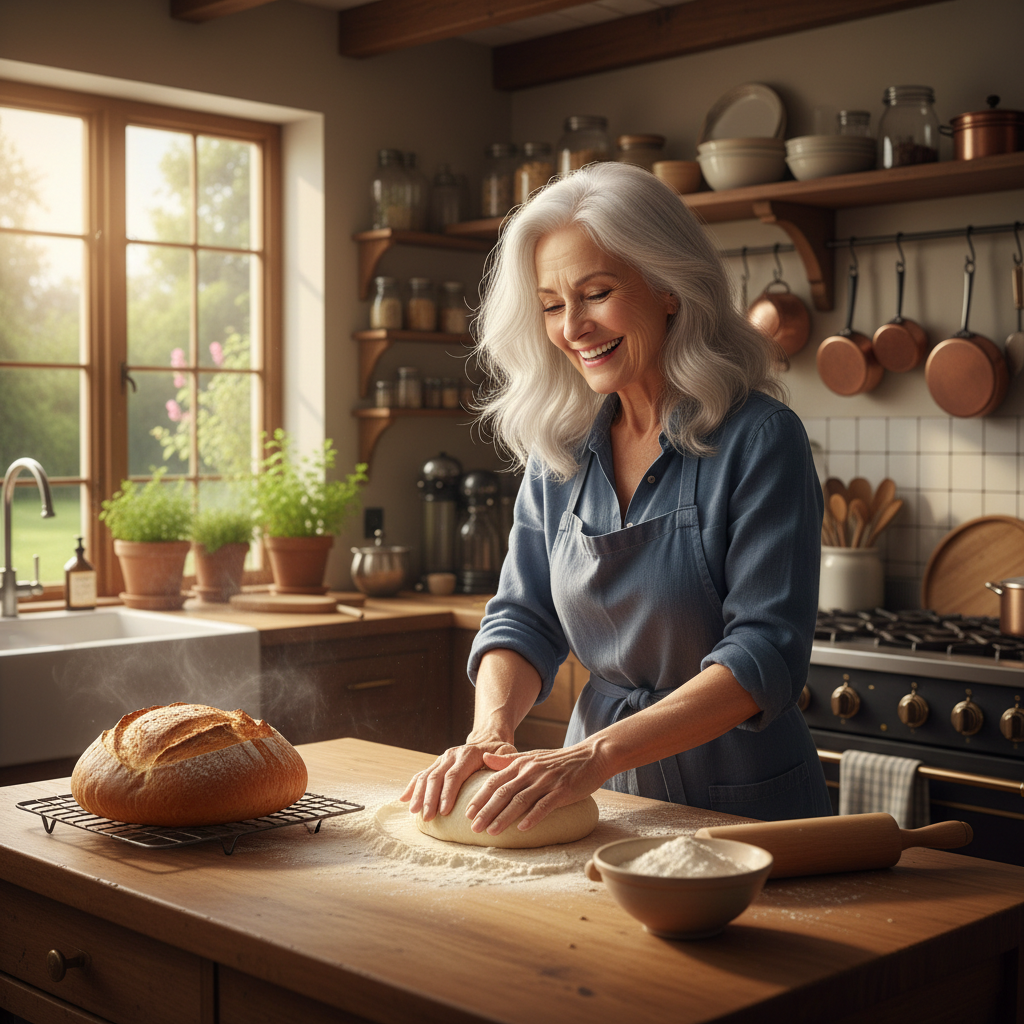
I was 52 years old when I made my first loaf of bread from scratch.
This is embarrassing to admit for a woman who taught home economics for over two decades. I had taught other people to bake bread, generations of students in fact, using a recipe I'd inherited from a colleague who had since retired and moved to Arizona. I had supervised the process. Graded the results. Offered constructive feedback on crust and crumb.
I had never once done it myself. In my own kitchen. For myself.
The reason, I told myself, was time. I was busy. I had a full teaching schedule, a house to manage, a mother in declining health who needed my attention on weekends. Bread required hours. I had none to spare.
What I actually had was fear, dressed up as busyness. Fear of failing at something I'd taught other people to do. Fear of looking foolish in my own kitchen. Fear of wanting something simple and beautiful and slow in a life that had become almost entirely fast.
The Rainy Saturday That Changed Everything
It was March, a cold and wet nowhere-to-be kind of Saturday, when I finally did it. I had flour, yeast, salt, and water. I had my grandmother's memory of kneading dough at a counter I could barely see over as a child. I had absolutely nothing else to do.
I mixed. I kneaded. I put the dough in a bowl covered with a damp towel and I waited. Waiting is the part that bread requires and that modern life has almost entirely forgotten how to do. I waited an hour while it rose. I shaped it. I waited again. I put it in the oven.
The smell that came from that oven forty-five minutes later is still one of the finest things I've encountered in this life. It was warm and yeasty and ancient, a smell that reaches back thousands of years to the first person who discovered that grain plus water plus heat equals something transformative.
The loaf was imperfect. Slightly dense on one side. The crust was good, though. Better than good.
I stood in my kitchen and ate a warm slice with butter and felt, for the first time in years, completely unhurried.
What the Science Says About Making Things With Your Hands
I know the feeling had a physiological basis. Research published in the British Journal of Occupational Therapy found that people who engage in regular creative activities, including cooking and baking, report significantly lower rates of depression, anxiety, and stress. The act of making something with your hands activates the brain's reward system in ways that scrolling through a phone or watching television simply do not.
Kneading dough, specifically, has been shown to reduce cortisol levels. The repetitive, rhythmic physical motion, press, fold, turn, press, fold, turn, engages the body and quiets the mental chatter in a way that approaches meditation. Bakers have known this intuitively forever. The research is just now catching up.
There's also something profound about the alchemy of it. Four ordinary, inexpensive ingredients become something fundamentally different through time and temperature. Something greater than the sum of its parts. In a life full of abstract work and invisible effort, bread is tangible evidence that you made something real. Scientists at the NIH have been exploring exactly this connection between making things by hand and genuine mental wellbeing, and the findings keep pointing in the same direction.
What Baking Taught Me About Patience
Here is what nobody tells you about bread: you cannot rush it.
You can turn up the heat. You can add more yeast. You can cover the bowl and put it near the stove. But the dough will rise at the pace the yeast determines, and the yeast answers to chemistry and temperature, not to your schedule.
I have been an impatient person for most of my adult life. I finish other people's sentences. I walk fast. I read the last chapter of novels before I'm halfway through. Bread has been, slowly and steadily, remedying this.
Every week for the past sixteen years, I've made at least one loaf. Sometimes two. I have learned to plan around the rise times instead of against them. I have learned that the waiting is not wasted time. It is the time the bread needs to become what it's meant to be.
I've started applying that logic more broadly. Some things require the time they require. Fighting that truth exhausts you. Working with it is a different thing entirely.
Start Before You're Ready
If you've ever wanted to bake bread and convinced yourself you couldn't, or wouldn't, or didn't have the time, I want to tell you that everything you've told yourself is wrong.
You need a bowl, a wooden spoon, a pan, and four ingredients. You need a free afternoon. You need to decide, once, that the imperfect loaf is better than the perfect one you never made.
I am 68 now. I've made bread on Christmas Eve and on the first morning after grief. I've made it for neighbors and for strangers and for my students and for myself on ordinary Tuesdays when nothing else made sense.
Every loaf is a small miracle that I help along. Every loaf reminds me that some of the best things are also the simplest.
Start on a rainy Saturday. Don't wait until you're ready. You'll never be more ready than right now.