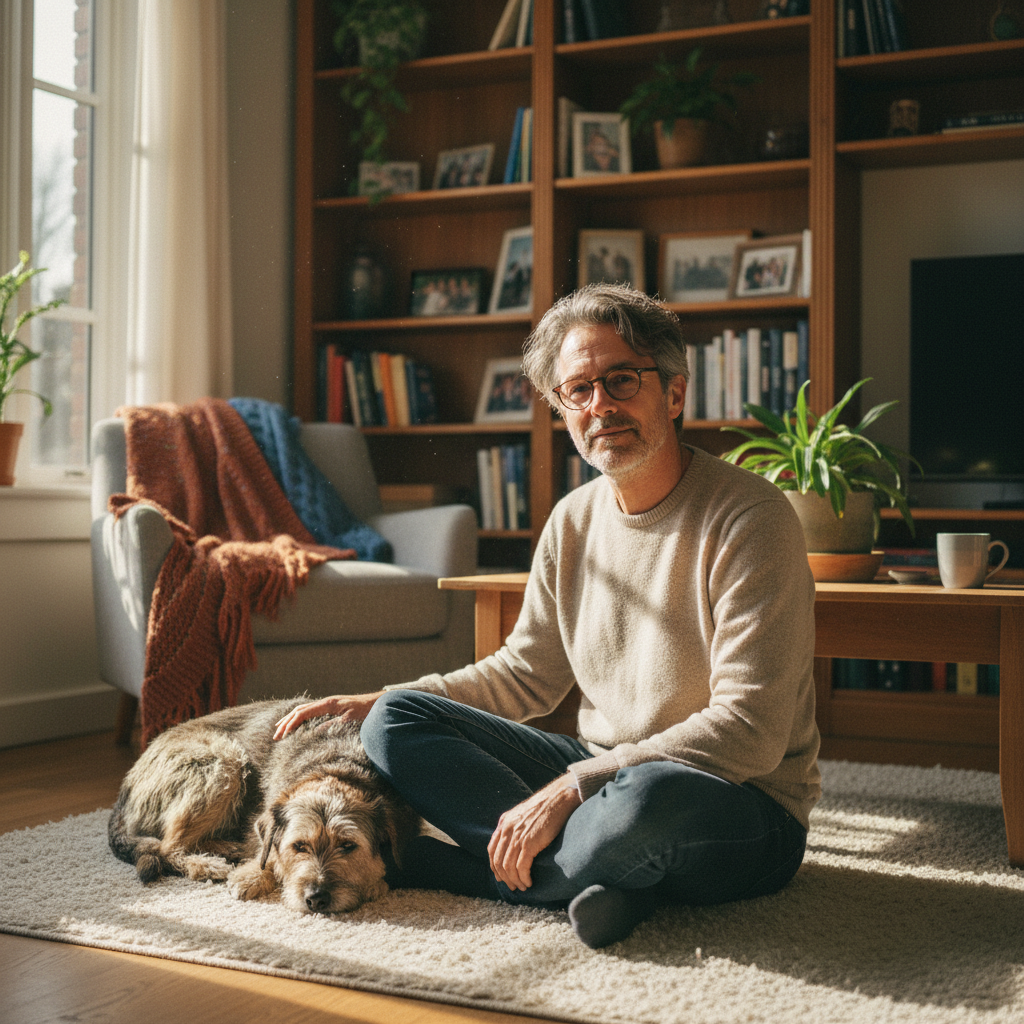
I was 54 when I walked into the shelter on a quiet Wednesday afternoon with no intention of leaving with a dog.
I had been volunteering there for six months. Tuesday and Thursday mornings, walking dogs, cleaning kennels, filling water bowls. It was something to do after my youngest moved to Portland and the house became a different kind of quiet than the kind I had planned for. I was fine, I told my friends. I just needed something to do with my hands.
He was in kennel twelve. Eight years old, the intake card said. Mixed breed, some hound, maybe some shepherd, nobody was certain. He had been surrendered by a family who was moving and couldn't take him. He had been there for six weeks. Most people walked right past him for the puppies at the end of the row.
He put his chin on the kennel door and looked at me with an expression I can only describe as philosophical. Like he had accepted the situation but hoped I might have other ideas.
I named him Wallace. We went home together that afternoon.
The Gift of a Dog Who Already Knows Things
Everyone warned me. Senior dogs have health issues. Senior dogs don't bond the same way. Senior dogs will break your heart when you lose them sooner than you planned.
All of this is true. None of it is the whole story.
Wallace already knew how to be in a house. He didn't chew things he shouldn't. He slept through the night. He understood "sit," "stay," and "let's go" without a single training session. He was, in the language of dog rescue, already "house-trained and settled." What this meant in practice was that we could simply be together from day one, without the exhausting early work of puppyhood.
What I didn't expect was how much he would teach me.
Wallace has two speeds: slow and asleep. His hips are stiff in the mornings, so we wait. We walk at whatever pace his joints allow that particular day, which is sometimes quite slow and sometimes slower than that. I have learned to structure my mornings around his arthritis, which means I have learned, finally, at 54, after decades of rushing, to structure my mornings around something other than efficiency.
The Research on Senior Pet Ownership
The American Heart Association has formally recognized pet ownership as a heart health factor. Studies show that dog owners have lower blood pressure, lower triglyceride levels, and lower rates of heart disease than non-dog owners. The daily walk a dog requires turns out to be one of the most consistent forms of moderate exercise adults actually stick with.
But there's something else the research documents that I find even more compelling: the role of pet ownership in reducing loneliness.
A 2020 study published in PLOS ONE found that pet owners were significantly less likely to report feelings of loneliness than non-owners, and that this effect was particularly strong for adults living alone. The mechanism isn't mysterious. Someone is there when you come home. Someone needs you in the morning. Someone is genuinely, tail-waggingly delighted by your presence every single day, regardless of what kind of day it's been.
I did not know, when I walked into that shelter, that I was looking for that. I thought I was just volunteering.
What He Gives Me Every Day
Wallace gets me outside every morning at 7:00, regardless of weather. He gets me talking to neighbors I hadn't spoken to in years, because people stop to greet him on every walk. He gives me something to narrate my day to. Not because he understands, but because the act of speaking aloud to a patient listener is its own kind of therapy.
He sleeps at the foot of my bed, just as my childhood dogs did, and in the morning when I reach down and he lifts his head to find my hand, I feel located in a way that is hard to describe but impossible to mistake.
He is eight, nine now, I suppose, since a year has passed. He moves slowly. He rests a great deal. He asks very little. He gives, in return, complete and uncomplicated presence.
I think that's the deal he's always offered. I'm just finally paying attention.
For Anyone Who's Wondering
If you are in your 40s or 50s and you're thinking about a dog, especially a senior dog from a shelter, I want to make the case directly: do it now, not later.
Don't wait until you have more time. You have time. A morning walk is time. An evening on the couch with a warm dog on your feet is time, spent exactly right.
The rescue community has a phrase I think about often: "Who rescued whom?"
I know the answer, in my case. It's not even close.