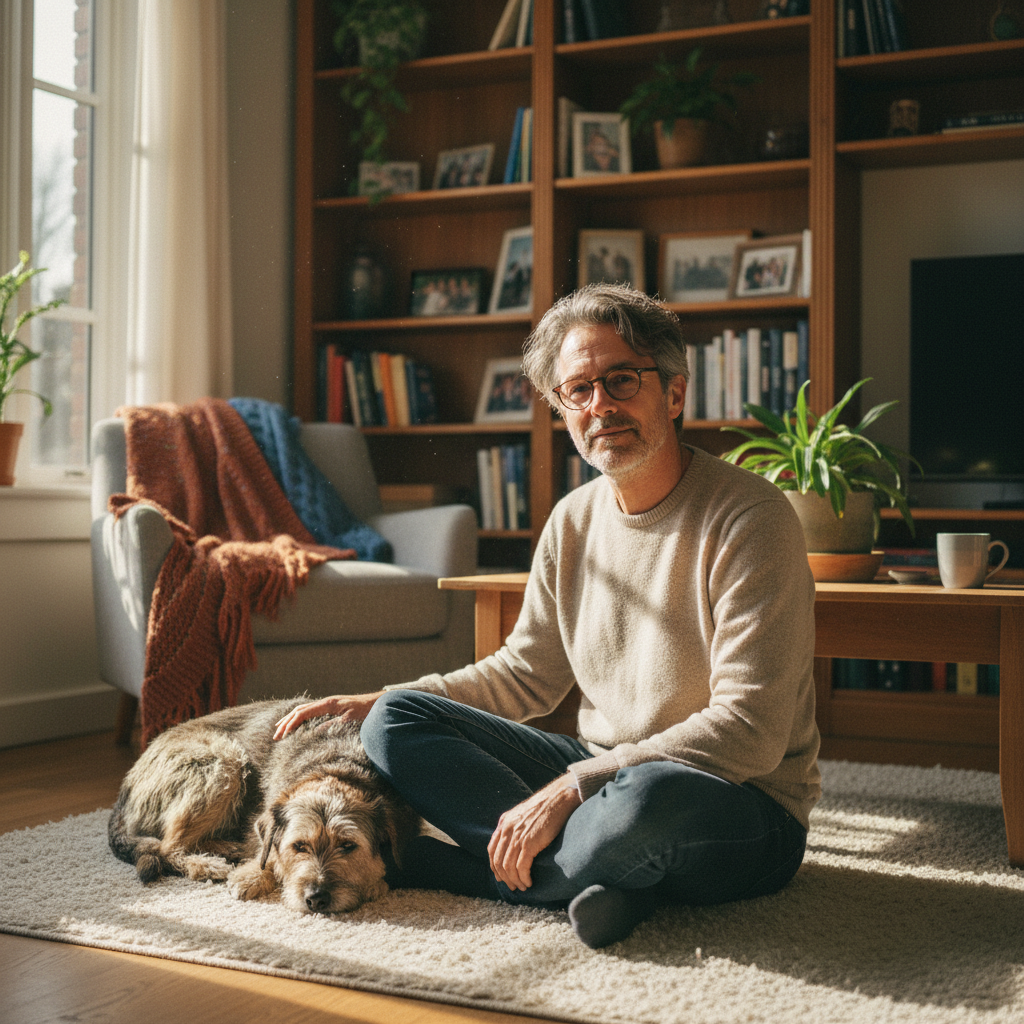
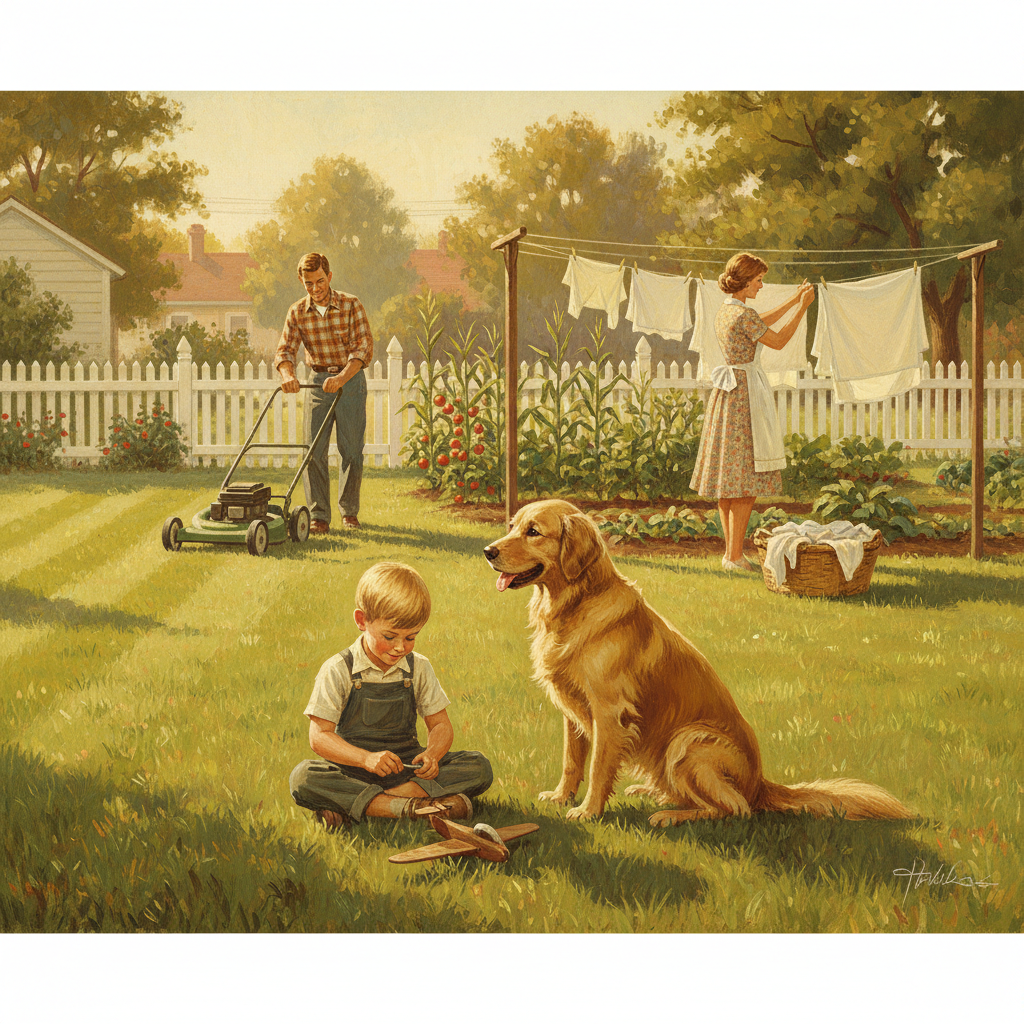
His name was Biscuit, though nobody could agree on who named him.
My brother swears it was him. My mother maintained, until the end of her life, that it had been my father's idea. Which was especially rich given that my father had looked at the shivering brown mutt on our back porch that wet October Tuesday and said, with complete conviction: "That dog is not staying."
Biscuit stayed for fourteen years. He slept at the foot of my parents' bed for every single one of them.
Dogs and the Boomer Childhood
I've been thinking about Biscuit a lot lately, now that I'm 71 and volunteering at the animal shelter twice a week, helping older dogs find homes with older people. And I've been thinking about what it meant to grow up in a time when the family dog was simply part of the household, unremarkably and completely. Not a lifestyle accessory or an Instagram subject, but a living creature woven into the ordinary days.
We know so much more now about what those animals were doing for us.
Research from the Human-Animal Bond Research Institute has found that pet ownership is associated with lower blood pressure, reduced cortisol levels, increased oxytocin production, and measurably lower rates of depression and anxiety. Children who grow up with pets show higher levels of empathy and stronger social skills. Elderly adults with companion animals make fewer doctor visits and report greater life satisfaction than those without.
Biscuit was not aware that he was a health intervention. He was aware that someone in our house might have food, and that the couch was comfortable, and that my brother's bedroom offered optimal napping conditions. But he was giving us all of that medicine anyway.
What the Dog Knew That We Didn't
I was 12 when Biscuit arrived. I was a serious, somewhat anxious child, the oldest of four, burdened with responsibilities I'd assigned to myself. I worried constantly. About school, about money, about things I couldn't have named if someone asked me.
Biscuit was not interested in my worries. He was interested in walks, and tennis balls, and whether I was going to finish my toast.
There's a clinical term now for what he was giving me: "non-judgmental presence." Therapists use it to describe the particular comfort of being with a creature who does not evaluate you, does not remember yesterday's failure, does not anticipate tomorrow's challenges. Dogs live entirely in the present tense. Spending time with them pulls you there too.
I did not know, at 12, that I was being taught to be present. I thought I was just petting a dog.
The Lesson of Loyalty
Biscuit was there when my grandmother died and my mother cried for three days. He was there when my father lost his job and the house went very quiet. He was there on every Christmas morning, insufferably excited, as though the holiday had been invented specifically for him. He was there for all of it. Not understanding any of it, but present for all of it.
That constancy, that showing up, is something I've watched humans struggle to maintain all my life. Biscuit never struggled with it. He was simply there. Every time. No exceptions.
John Bowlby, the British psychiatrist who developed attachment theory, argued that secure attachment, the feeling that someone is reliably there for you, is the foundation of psychological health across the lifespan. We were getting that from a brown mutt of uncertain heritage every day of our childhoods.
What I Know Now, at the Shelter
The hardest part of my volunteer work is watching older dogs get passed over. People come in wanting puppies. The seven-year-old beagle mix, the nine-year-old shepherd, the twelve-year-old lab who wants nothing more than to lie at someone's feet. They wait.
I want to tell every person who walks past them: that dog will give you everything. The full presence, the loyalty, the daily reminder that someone is glad you came home. And an older dog has already done the hard work. They know how to be in a house. They know how to love a person.
Biscuit was not a puppy when he found us. He was maybe two, maybe three. No one knew. He had clearly belonged to someone who hadn't treated him especially well. He was cautious at first, watching us from the doorway, not quite trusting that this was real.
By the end of the first week, he was asleep on my father's feet.
Come Home to Something Waiting
If you are living alone and the house feels too quiet, and I know that feeling intimately, I want you to consider the animal shelter in your town. Not because you need a project, not because you need something to take care of, but because you deserve to come home to something that is genuinely, completely glad you're there.
That gladness is not small. Science confirms it. And anyone who ever had a Biscuit already knows it.
He showed up wet and limping and my father said absolutely not.
He was the best thing that ever happened to our family. My father would have told you that himself, in his last years. Always with a slight gruffness, always looking just past your shoulder when he said it.