
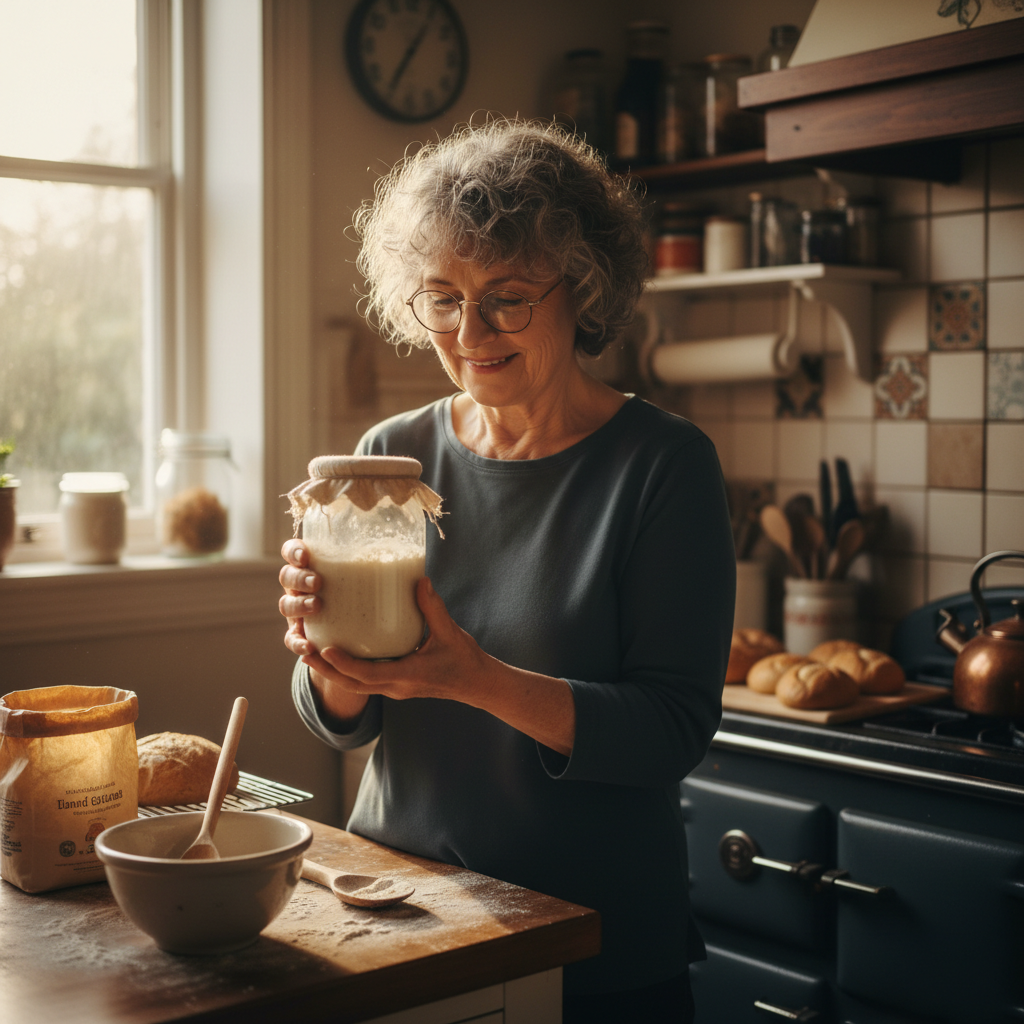
My first sourdough starter smelled like nail polish remover and refused to rise. My second one turned pink, which I've since learned is a very bad sign. My third one seemed promising for eight days and then went still and flat, which I can only describe as a quietly personal rejection.
I almost gave up after the third one. I'm glad I didn't.
I was 69 when I started baking bread seriously. Not by recipe box kits or supermarket dough, but from actual flour and water and wild yeast I cultivated in a jar on my kitchen counter. It began during the lockdown, which gave me both the time and the existential need to make something with my hands that was alive.
What Sourdough Actually Is
For those who haven't ventured into this particular obsession: sourdough bread is leavened not by commercial yeast but by a "starter," a living culture of wild yeast and bacteria that you feed with flour and water every day. It ferments. It bubbles. It rises and falls on a schedule that has its own logic, connected to room temperature and humidity and the specific flour you use.
You are essentially keeping a pet made of carbohydrates.
The starter I have now, my fourth attempt, alive and healthy in a mason jar on my counter, I've named Norman. I have been feeding Norman every morning for two and a half years. He is, in some ways, my most reliable relationship.
What the Bread Taught Me
Patience first. Sourdough does not respond to urgency. You cannot rush fermentation. You cannot demand that the dough be ready before it is ready. This is a lesson I apparently needed, because I have spent most of my life doing exactly that, pushing, managing, requiring outcomes on my schedule.
The bread pushed back, gently, every time.
Failure second. I've produced loaves in two years that I wouldn't serve to someone I disliked. Dense bricks. Gummy centers. One loaf that, when tapped on the bottom, made a sound like a health problem. And then I've produced loaves that, when I cut them open, had an interior architecture that genuinely moved me. The failure is not the opposite of learning. It is the learning.
Engagement with the body third. Kneading dough is physical in a way that most of my life is not anymore. You feel the gluten develop under your hands. You read the dough. Is it too tight? Too slack? Does it spring back when you poke it? This kind of tactile attention, researchers are increasingly finding, has real benefits for mental health and cognitive engagement in older adults. And the National Institute on Aging notes that hands-on hobbies can support both emotional wellbeing and a sense of purpose as we get older. That tracks with my experience completely.
The Social Part I Didn't Expect
I started bringing loaves to neighbors. One neighbor, Barbara, who I'd waved at for six years without having a real conversation, asked if I would teach her. I said yes.
We bake together every other Saturday now. She's on her second starter, and it's thriving. We have become actual friends, over flour and water and the particular pleasure of a good crust.
Norman has, against all reasonable expectation, expanded my social world.
What I'd Tell You
If you have ever thought about making bread, or pottery, or building birdhouses, or learning to play the ukulele, I am here to tell you that 69 is not too late. Or 74. Or 81.
The point is not to be good at it immediately. The point is to have something alive in your kitchen, in your hands, in your days, that requires you to show up for it.
Norman has been very patient with me in this regard. I try to return the favor.