
I was nineteen years old in 1985 when a boy I knew from the neighborhood was hospitalized with something nobody could quite name.
He was twenty-two. He had moved to San Francisco the year before. He had called me from a payphone to tell me he loved it there, the fog, the color of the bay, the feeling of being somewhere that made room for him. Three months later he was in a hospital. By Christmas he was gone.
We did not have the language yet. The doctors had the language. The CDC had the language. But somehow it had not made it all the way to the people who needed it most, which was everyone, and the silence around what was happening was not just ignorance. Some of it was chosen.
A Disease That Was Named Four Years In
The epidemic did not begin in 1985. It began, in documented American medical history, in June of 1981.
That month, the Centers for Disease Control published a notice, five paragraphs buried in a weekly bulletin, describing an unusual cluster of a rare lung infection called Pneumocystis carinii pneumonia in five gay men in Los Angeles. All five were previously healthy. All five had severely compromised immune systems. Nobody had a name for what was happening to them.
For the next year, the CDC received similar reports from New York, from San Francisco, from Miami. The disease was spreading. The federal government was largely silent. The Reagan administration did not publicly acknowledge AIDS until 1987, six years into the epidemic, by which time tens of thousands of Americans had already died.
The word AIDS, Acquired Immune Deficiency Syndrome, was adopted in 1982. By then, the disease had already killed hundreds of people.
The Faces We Were Supposed to Forget
The early coverage of the AIDS crisis was almost uniformly dehumanizing. Mainstream newspapers that covered it at all tended to describe the disease as a "gay plague" or to frame the victims as somehow responsible for their own illness. The New York Times's first story on the epidemic ran in 1981 under the headline "Rare Cancer Seen in 41 Homosexuals." It was 419 words long. It ran on page A20.
The people dying were not abstractions. They were sons and brothers and neighbors and friends and artists and teachers and nurses and musicians. The AIDS Memorial Quilt, begun in 1987 by activist Cleve Jones, grew to over 50,000 panels. Each one held a name, a face, a life that had been real. When it was displayed on the National Mall in Washington in 1987, it was larger than a football field and it still did not hold everyone.
It has never held everyone.
ACT UP and the People Who Would Not Be Quiet
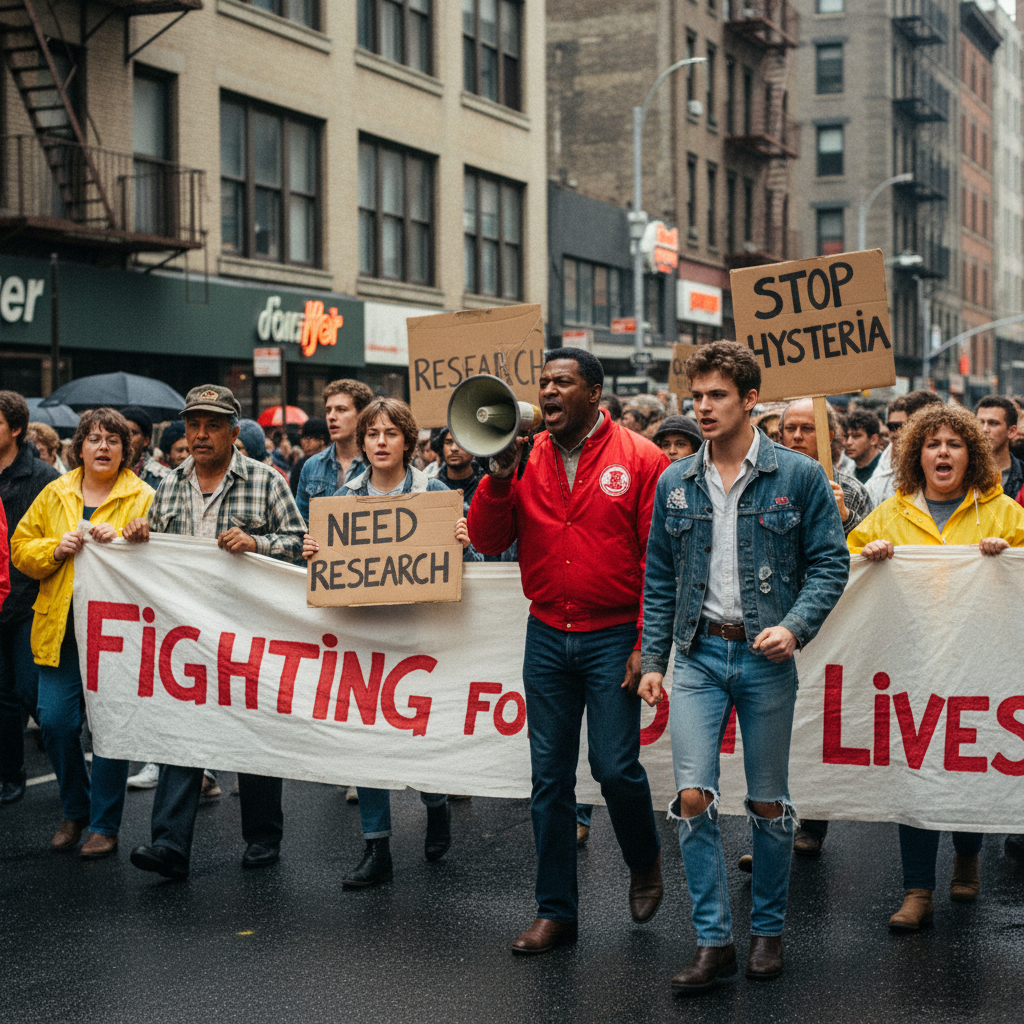
What changed the course of the epidemic, what forced the government and the pharmaceutical industry and the medical establishment to respond, was not sympathy. It was rage, organized and sustained.
In 1987, a group called ACT UP (AIDS Coalition to Unleash Power) was founded in New York City. Their slogan was "Silence = Death." Their tactics were confrontational, loud, and entirely deliberate. They shut down the Food and Drug Administration. They disrupted the New York Stock Exchange. They staged a funeral march down Fifth Avenue carrying the bodies of people who had died while the government delayed drug approvals that might have saved them.
They were called extremists. They were called disruptive. They were right.
Because of ACT UP and the broader activist movement, the FDA dramatically accelerated its drug approval process. Experimental treatments became accessible. The language of "compassionate use" entered the medical vocabulary. People lived who would have died.
What It Did to a Generation
For those of us who were young in the 1980s, the AIDS epidemic was not a historical event. It was the weather. It was the background of everything, the reason some of our friends were suddenly gone, the reason sex was suddenly scary, the reason funerals became a thing you went to regularly before you were thirty.
It also taught us something about how a society decides who matters.
We watched the federal government look away from dying people for years because those people were gay, or Black, or poor, or users of intravenous drugs. Categories that, the silence implied, did not fully qualify for the urgency that would have been applied automatically to different people dying of a different disease. The lesson was not subtle. It has never left us.
The Numbers, Because They Matter
By the end of 1995, AIDS had killed over 300,000 Americans. It was the leading cause of death for Americans between the ages of 25 and 44. In some cities, the life expectancy of gay men dropped by years in a single decade.
The introduction of antiretroviral combination therapy in 1996 changed the arithmetic of survival dramatically. People who had been given months to live lived instead for decades. HIV became, for those with access to treatment, a manageable chronic condition rather than a death sentence.
Access remains deeply unequal. Black and Latino Americans continue to be diagnosed at rates far exceeding their share of the population. The epidemic is not over. It changed shape, and then it receded from the front pages, and then the country largely moved on.
Some of us did not move on. Some of us will not.
What We Owe the People We Lost
The boy from my neighborhood was named Christopher. He was twenty-two. He loved San Francisco fog and loud music and terrible action movies. He had a laugh that could change the temperature of a room.
I am telling you his name because for a long time, too many people like him were buried without their names in newspaper coverage, reduced to statistics, or erased entirely from the public record of what happened to America in those years.
Remembering is not nostalgia. It is obligation. The people who died in the first decade of the AIDS epidemic, before the drugs, before the political will, before the country decided they were worth saving, died in the middle of a failure of human decency that we should never stop examining.
We owe them that much. We owe them more.