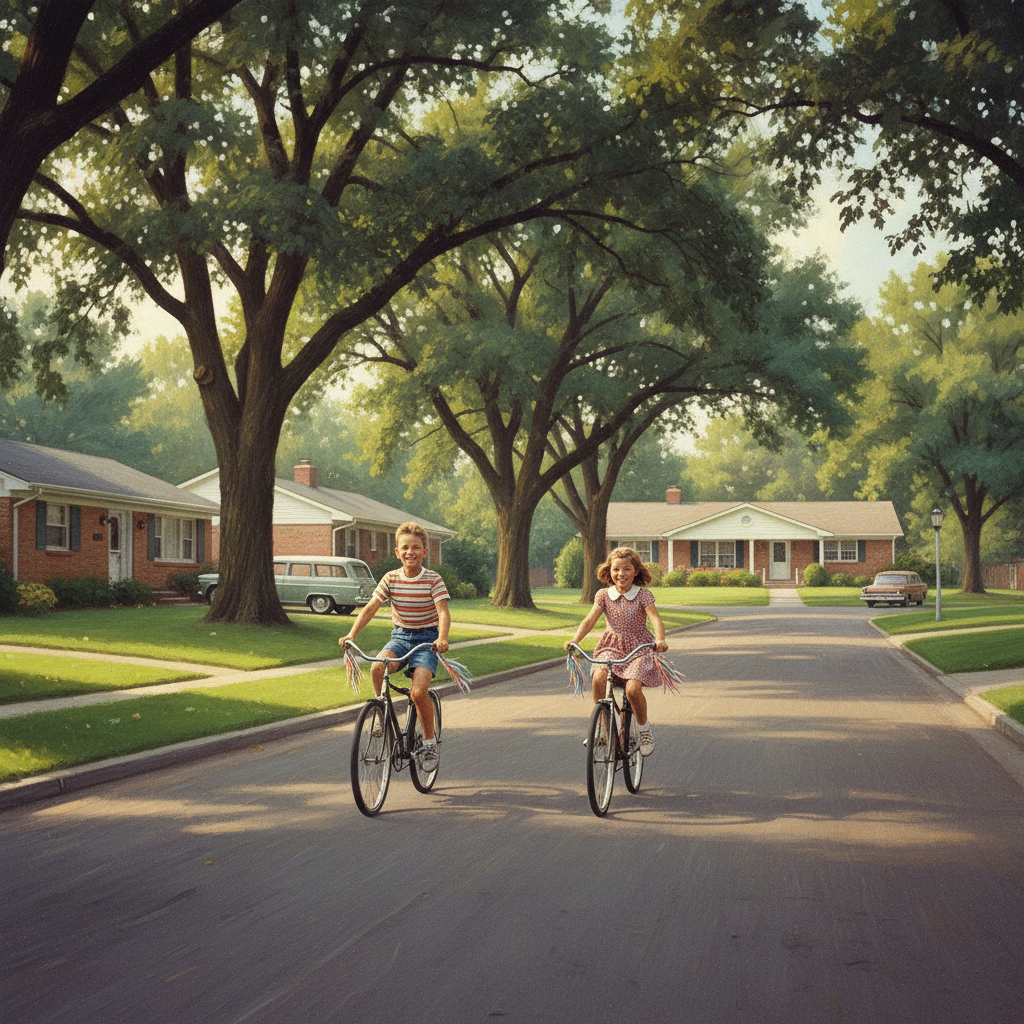
My mother's exact words, on a summer morning in 1965, were: "Go outside and don't come back until dinnertime."
She said this without anxiety. Without a list of approved activities. Without first checking the neighborhood crime statistics or consulting the pediatrician about age-appropriate independent play. She said it the way she said everything: matter-of-factly, with confidence, and with the unmistakable implication that the matter was settled.
I went outside. I didn't come back until dinner. And every day for the next ten summers, I did the same thing.
The Unscheduled Childhood and What It Built
I'm 69 now. I've had a lot of time to think about what those free summers actually gave me. Not just the calloused feet and the ability to identify every make and model of American car from 1955 to 1972, but the deeper things. The things that turned out to matter.
Psychologist Peter Gray at Boston College has spent decades studying what he calls "free play," meaning unstructured, unsupervised, child-directed activity, and what its decline has cost us. His research, along with that of Jonathan Haidt and Jean Twenge, documents a striking correlation: as rates of children's free play have fallen since the 1980s, rates of childhood anxiety, depression, and poor resilience have risen sharply.
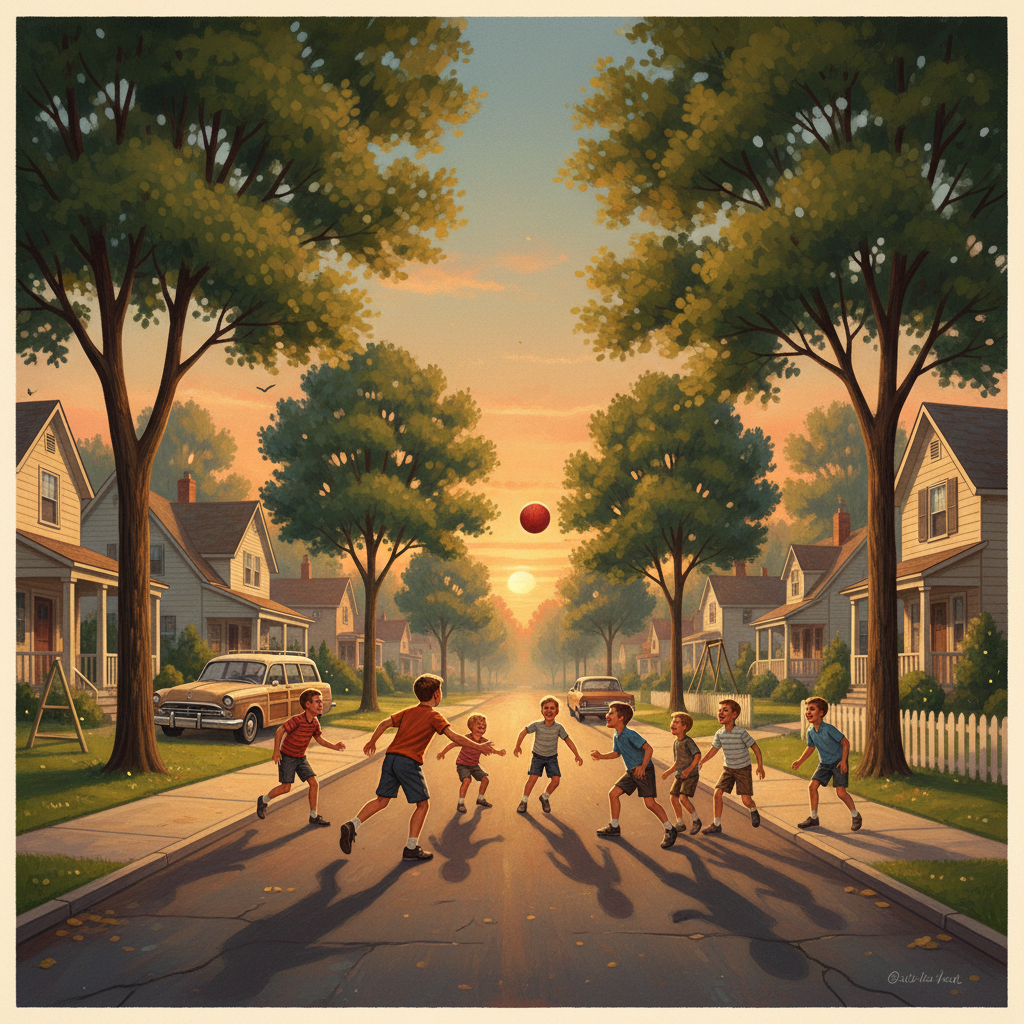
We were, without knowing it, building resilience every day on that cracked concrete.
When you make your own game, you learn to negotiate. When no adult settles the dispute, you figure it out or the game ends. When you fall off the fence, and we all fell off the fence, you get up and decide whether to try again or go home. These are not trivial lessons. They are the foundation of self-regulation, problem-solving, and what psychologists now call "executive function."
We learned them by playing kickball in the street.
The Social Architecture of the Old Neighborhood
There was a social structure to those summers that looked like chaos from the outside but operated with its own logic.
The older kids, twelve, thirteen, fourteen years old, watched out for the younger ones without being asked. You couldn't help it. You were all out there together. If Tommy from down the street skinned his knee, someone walked him home. If the little Marchetti girl wandered too far, somebody noticed.
This is what sociologists call "informal surveillance," the organic, neighborly watchfulness of a community that knows its people. We had it in abundance. Nobody organized it. It emerged from proximity and shared space.
I watched it disappear over the decades. Backyards got fenced. After-school activities multiplied. Kids went inside and stayed there. And something that had regulated itself for generations, this informal web of looking out for one another, quietly came undone.
Boredom Was Not the Enemy
Here is something nobody tells children today: boredom is not a problem to be solved. It is a condition to be inhabited.
My mother had no programming for us. When we said we were bored, and we said it constantly, dramatically, as though it were a medical emergency, she said, with magnificent indifference: "Then find something to do."
We always did. We built forts. We organized elaborate games with rules so complicated only we understood them. We lay in the grass and watched clouds. We read books we found on shelves in no particular order. We dug holes for reasons that made sense at the time.
Neuroscientists have recently become very interested in what happens in the brain during boredom. It turns out that the "default mode network", the mental state that activates when we're not focused on a task, is associated with creativity, self-reflection, empathy, and the kind of free-ranging imagination that produces innovation. Boredom, properly inhabited, is where good ideas come from.
We were in that state for roughly ten hours a day, every summer, for a decade. Whatever creativity I have, and I've found more of it in retirement than I ever expected, I trace back to those long unscheduled afternoons.
What We're Still Carrying
I know that our childhoods weren't perfect. The 1960s had plenty wrong with them, and I'm not interested in pretending otherwise. But there are gifts I received from those years that I couldn't have named at the time and can now see very clearly.
I'm not afraid to be uncomfortable. I figure things out when plans fall apart. I can entertain myself. I can sit with silence. I can walk somewhere with no particular destination and be okay with that.
These are things that therapy now teaches to adults who didn't get them young. We got them for free, from the neighborhood, from the screen door swinging shut behind us in the morning.
The Permission We Can Still Give Ourselves
Here is what I've discovered in retirement: the unscheduled day, the one you don't fill with obligations and productivity and organized activity, is still the most generative kind.
I try now to have at least one morning a week with no plan. I walk until I feel like stopping. I sit somewhere and watch what happens. I let myself get a little bored and wait to see what my mind does with it.
It does, I find, exactly what it always did.
Go outside. Don't come back until dinner. And trust that whatever you find out there will be exactly enough.