For two years after David died, I couldn't open the door to his workshop.
Not because I didn't want to. Because every time I turned the handle, something in me pulled back. The smell of sawdust and linseed oil was too much. The half-finished birdhouse on the bench, the one he'd been building for our grandson, the last thing he ever worked on, was too much.
I'd stand at the door, hand on the knob, and then walk away and make tea instead.
The Morning I Finally Went In
It was a Tuesday in March, two years and four months after the funeral. I'd been praying about it. Not eloquently, the way I did when I was younger, but in the stumbling, honest way grief teaches you to pray. *Lord, I don't know what to do with this room. I don't know what to do with any of this.*
I don't know why that Tuesday was different. Maybe it was the prayer. Maybe God just decided I'd waited long enough.
I stood in the middle of his workshop for a long time, just breathing. I touched his tools, his chisels, his planes, his Japanese saw he'd ordered special from a catalog. I sat on his worn wooden stool.
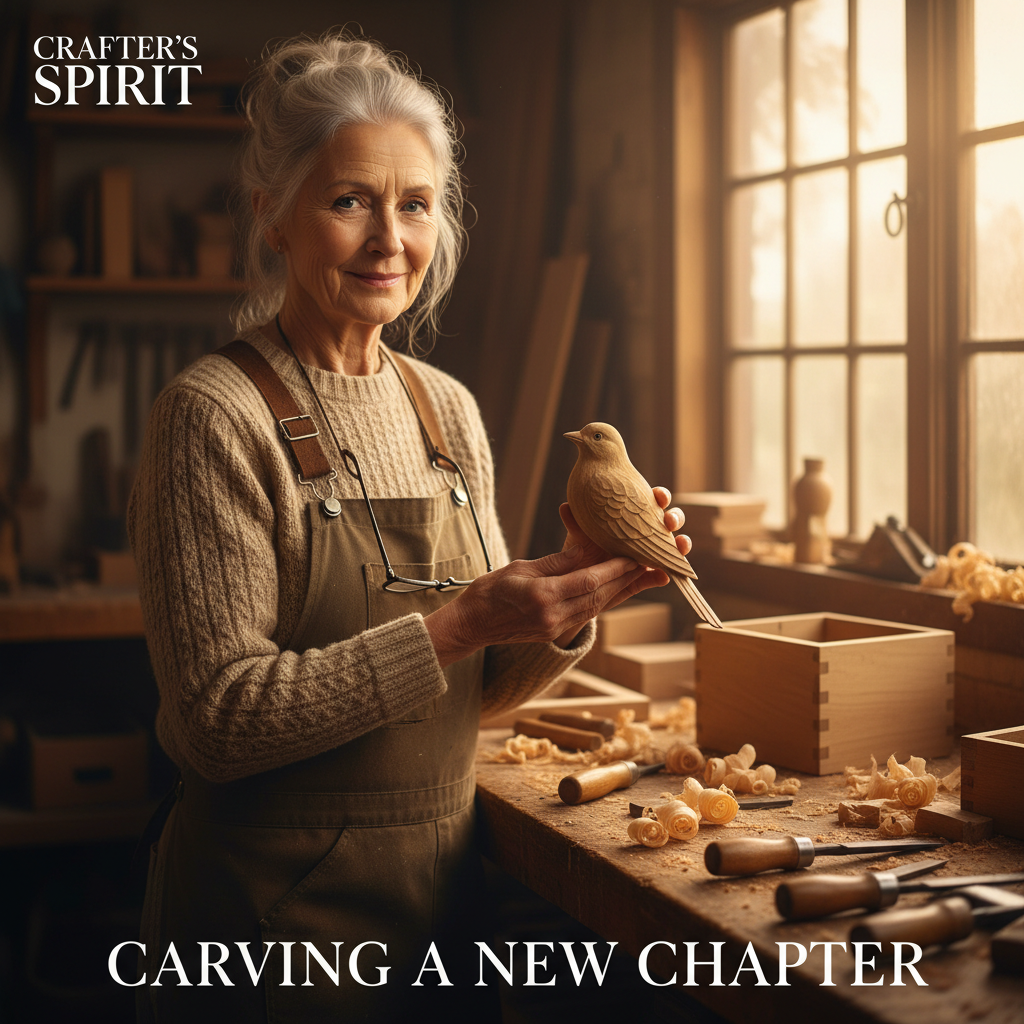
And then, without quite deciding to, I picked up the chisel and sat down at the birdhouse.
I had no idea what I was doing. I YouTube'd "how to use a wood chisel" right there in the workshop on my phone. I made a mess of the first joint. I made a better mess of the second.
I was in there for three hours. I didn't think about David the entire time. And then I cried for twenty minutes straight when I came in for lunch.
Both things were exactly right.
What I've Built in the Two Years Since
The birdhouse, finished, lives in our grandson's bedroom. After that came a small cutting board, a picture frame, a set of wooden spoons, and a wobbly but functional bookshelf that my daughter pretends is perfect.
I'm not good at this. That's not the point.
The point is that I have claimed this space. It was David's; now it's ours. His tools are still his tools. I've learned what each one is for, and I use them carefully, the way he would have wanted. But the work that happens in that room now has my hands in it too.
What Grief Taught Me About Finding Yourself Again
My pastor told me once that grief is the price of love, and that God doesn't waste either one. I didn't fully understand that until I was standing in sawdust, crying over a joint that finally fit right.
I spent the first years of widowhood trying to resume my previous self, the self that existed in relationship to David. That self is gone. She left with him.
Researchers who study grief and loss after the death of a spouse describe something they call "identity reconstruction," the gradual, sometimes surprising process of rediscovering who you are outside of a long partnership. I didn't know there was a name for what I was fumbling through. It helped to learn there was.
The self I've found in the workshop is someone I didn't know was in there: patient, focused, willing to fail, genuinely pleased by a joint that fits properly. Someone God apparently had more work to do with.
There's also something to be said for working with your hands. Learning a new hands-on skill has real benefits for mental health and focus, especially during times of stress or transition. I didn't pick up that chisel for therapeutic reasons. But I'd be dishonest if I said it hasn't been exactly that.
I am 71 years old. I am, in some ways I never expected, still becoming myself.
That workshop door is never closed anymore.