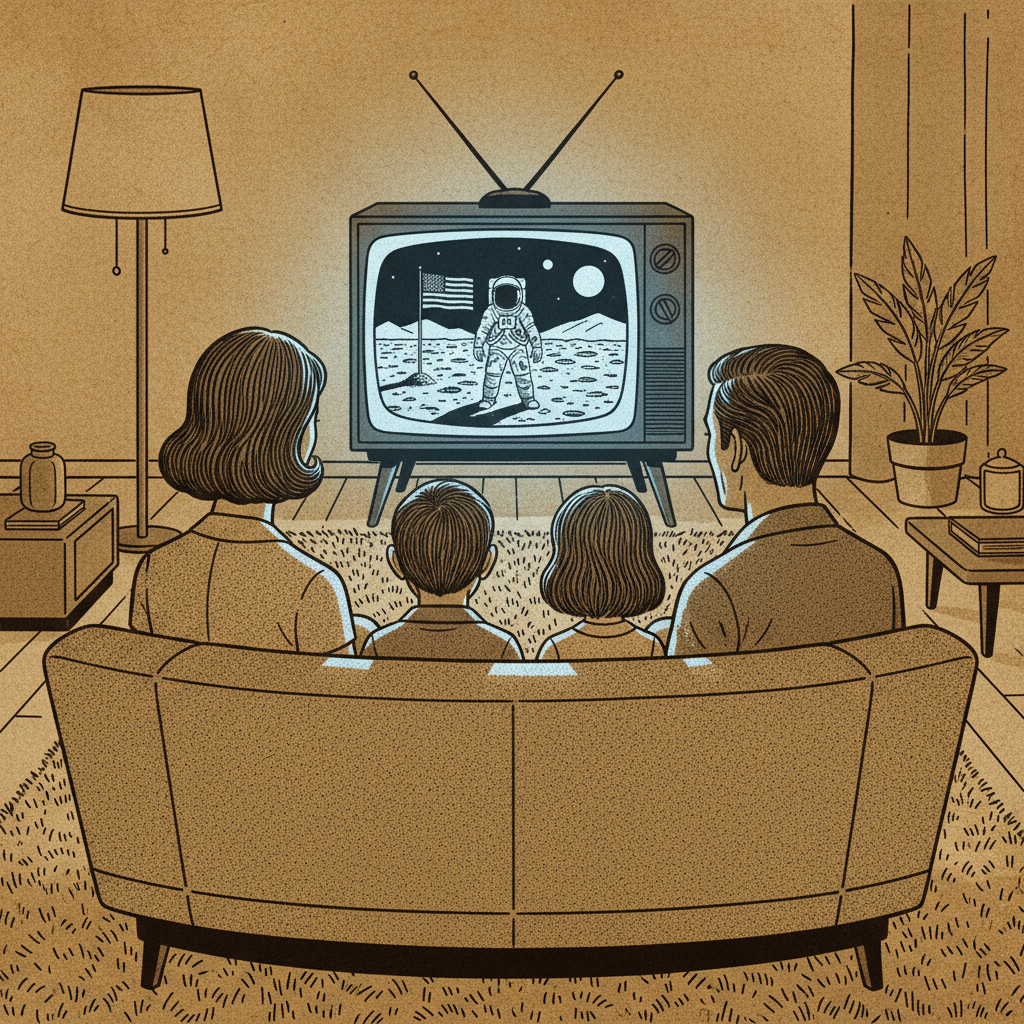
I was fourteen years old, sitting on the living room floor in my parents' house in Akron, Ohio.
The television was a Zenith console, the kind with wooden sides and a dial you had to physically turn. It was July 20, 1969, and every neighbor on our block had squeezed into someone's house to watch. There were nine people in our living room that night, including Mr. Kowalski from two doors down who had never, in my memory, set foot inside our house before.
We all sat there in the blue-gray flicker of that television and watched a human being walk on the moon.
What the Space Race Actually Was
By 1969, my generation had been living inside the Space Race for our entire conscious lives. It had begun in earnest on October 4, 1957, when the Soviet Union launched Sputnik, a 184-pound metal sphere that circled the Earth every 96 minutes and did nothing except beep. That beep terrified the United States more than almost anything that came before it.
The fear was this: if the Soviets could put a satellite in orbit, they could put a nuclear warhead anywhere on Earth.
President Eisenhower responded by creating NASA in 1958. President Kennedy escalated the mission in 1961 with one of the most audacious public commitments in American history: we would put a man on the moon before the end of the decade.
He said this when we had not yet even managed to put a man in orbit for more than fifteen minutes.
For those of us growing up in the late 1950s and 1960s, space was not a distant abstraction. It was in our classrooms, our toys, our breakfast cereal. We collected trading cards with astronaut photos. We did school projects on rocket fuel. We watched Alan Shepard become the first American in space in 1961. We watched John Glenn orbit the Earth in 1962. We grieved when Gus Grissom, Ed White, and Roger Chaffee died in the Apollo 1 launchpad fire in 1967.
We were not passive observers. We were invested.
The Astronauts Were Our Heroes
The original Mercury Seven astronauts, Shepard, Glenn, Grissom, Scott Carpenter, Gordon Cooper, Wally Schirra, and Deke Slayton, were the first American celebrities I remember genuinely worshipping. Not movie stars. Not musicians. Engineers and test pilots who were willing to sit on top of a rocket and light the fuse.
Neil Armstrong, who walked on the moon first, was almost frustratingly modest about it afterward. He gave his famous "one small step" line and then went back to being quiet and Midwestern and decent. I have always respected that about him.
Buzz Aldrin, the second man on the moon, called the lunar surface "magnificent desolation." Two words that have stayed with me for sixty years, because they are so exactly right.
The Moment Itself
At 10:56 PM Eastern time on July 20, 1969, Armstrong descended the ladder of the Eagle lunar module and stepped onto the surface of the moon.
Walter Cronkite, covering it live on CBS, took off his glasses and wiped his eyes. Walter Cronkite, the most trusted man in America, a journalist who had covered World War II, presidential assassinations, and riots, could not hold it together. That told us something.
In our living room in Akron, nobody said anything for a long moment. Then Mr. Kowalski, who had survived the Battle of the Bulge and never talked about it, said very quietly: "My God."
That was the right response.
What It Did to a Generation
Psychologists and historians who study generational identity have written extensively about what Robert Putnam calls "peak experiences," shared events that bond a generation into a collective identity. For baby boomers, the moon landing is the clearest example. Nearly every American who was alive and old enough to understand what they were watching remembers exactly where they were.
But its effect was deeper than memory. It told an entire generation of young people, particularly young women and young people of color who had been told in every possible way that certain doors were closed to them, that the impossible was negotiable.
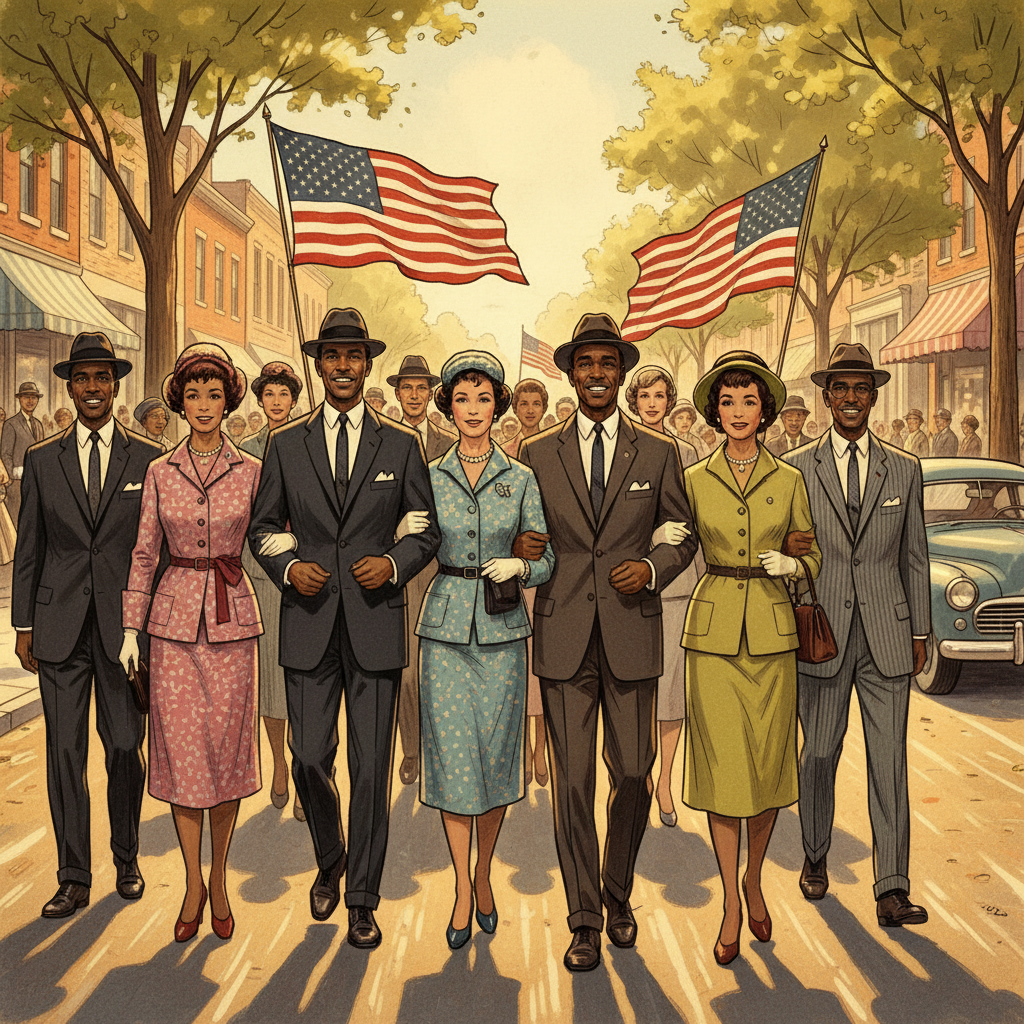
Katherine Johnson, the Black mathematician at NASA whose calculations were essential to the success of the mission, had been working in a segregated computing pool. She did the math that sent men to the moon. A generation of children watching the moon landing did not know her name yet. But they would.
What the Moon Still Means
I am 71 now. I have watched the moon rise over five decades of American life, through war and scandal and loss and renewal. I have raised children under it. I have buried people I loved under it.
It still makes me stop, sometimes, on a clear night, and look up.
We went there. Twelve human beings walked on that surface. They left retroreflectors that scientists still bounce lasers off today to measure the precise distance from the Earth.
The footprints are still up there. The moon has no weather, no wind. Nothing to erase them. They will be there for millions of years.
A fourteen-year-old girl in Akron watched them being made.
That was us. That was our generation. And whatever else you might say about the 1960s, and there is plenty to say, we were alive when the species first left its home world and touched another.
Nothing before or since has felt quite like that.