In the third grade, my teacher told us that if we saw a bright flash outside the window, we should immediately get under our desks and cover our heads with our arms.
She said this the way she said everything: calmly, matter-of-factly, as though it were as sensible as looking both ways before crossing the street.
I went home and told my mother. She nodded and said, "That's right." Then she started making dinner.
This was the Cold War childhood.
What the Cold War Actually Was
The Cold War was a prolonged geopolitical standoff between the United States and the Soviet Union that lasted from roughly 1947 to 1991. At its core, it was a competition between two nuclear-armed superpowers who both understood that direct conflict between them would likely end human civilization.
The strategy that emerged from this understanding was called Mutually Assured Destruction, or MAD. An acronym that military strategists apparently deployed without irony. The theory was that if both sides had enough nuclear weapons to destroy the other many times over, neither side would ever use them first.
George Kennan, the American diplomat and historian whose 1946 "Long Telegram" from Moscow shaped American Cold War strategy for decades, argued for a policy of containment. Not confronting the Soviet Union directly, but preventing it from expanding its influence. His ideas would guide American foreign policy through multiple administrations.
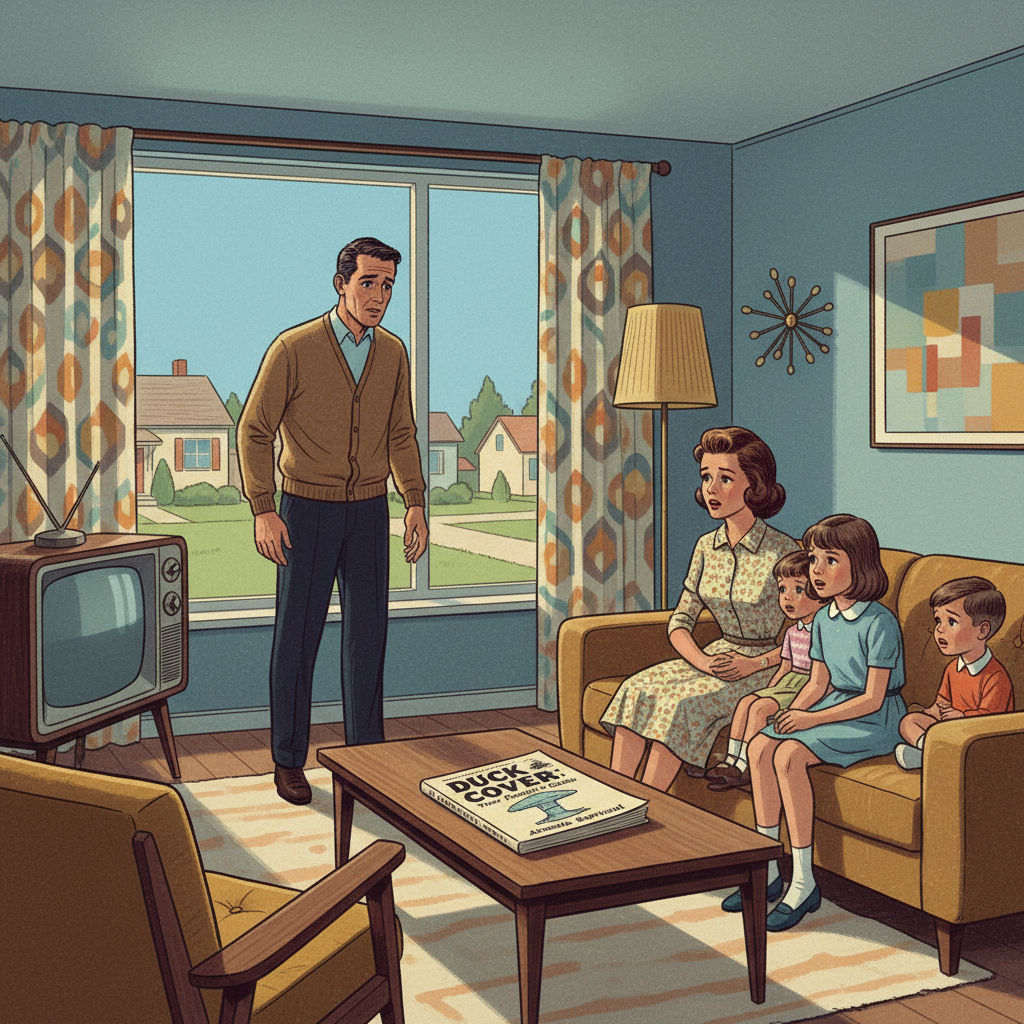
For children in American suburbs in the 1950s, this geopolitical abstraction translated into very concrete rituals of fear.
Duck and Cover
In 1952, the Federal Civil Defense Administration released a short film called "Duck and Cover," featuring a cartoon turtle named Bert who pulled into his shell whenever he saw a flash. Children across America watched it in school assemblies.
The film's basic advice, get low, get under something, cover your exposed skin, was not entirely without merit for people near the periphery of a nuclear blast. For anyone closer, it was, to put it gently, insufficient. But it gave the government something to tell people to do, and it gave children the feeling that survival was possible with the right preparation.
That feeling, that preparation could protect you from the unprotectable, was an important part of Cold War psychology. Elaine Tyler May, a historian at the University of Minnesota whose book *Homeward Bound* is the classic study of Cold War domesticity, argues that the emphasis on home, family, and suburban life in the 1950s was partly a psychological response to existential threat. If the world outside was dangerous and uncertain, the house became a fortress of safety and control.
Our parents built fallout shelters in backyards. They stocked them with canned goods and water. Some families in our neighborhood had one. We thought the Hendersons were a little extreme. We also noticed that Mr. Henderson seemed calmer than other fathers.
October 1962
For thirteen days in October 1962, the world came as close to nuclear war as it has ever come.
The Cuban Missile Crisis began on October 16, when American U-2 spy planes photographed Soviet nuclear missile installations being constructed in Cuba, ninety miles from Florida. President Kennedy and Soviet Premier Nikita Khrushchev spent thirteen days negotiating, bluffing, and ultimately stepping back from the edge.
I was twelve years old. My father watched the news every night with a particular stillness that I had not seen before. My mother started keeping the pantry extra full. Nobody said anything about it directly to me. But I was twelve, not stupid.
Robert McNamara, who served as Secretary of Defense under Kennedy and later reflected extensively on the crisis, said in his memoir that he went to bed on several of those nights genuinely unsure whether there would be a morning.
We later learned that a Soviet submarine commander, Vasili Arkhipov, prevented the launch of a nuclear torpedo against American ships during the crisis by refusing to authorize it when the other two required officers voted yes. One man. One decision. The world.
What It Did to Us Psychologically
Psychologists who have studied the effect of chronic low-level threat on child development, including Robert Jay Lifton, whose work on nuclear psychology and what he called "nuclearism" helped define the field, found that children who grew up during the height of the Cold War showed measurable effects. Higher rates of existential anxiety, a heightened sense of the fragility of life, and in many cases a paradoxical capacity for present-moment appreciation.
If the world might end, the argument went, you might as well live in it fully.
I do not know if that is why baby boomers became the generation we became, restless, questioning, impatient with authority, inclined toward intensity. But I do not think it's coincidental.
The Wall Came Down
On November 9, 1989, I was sitting in my kitchen in Minneapolis listening to the radio when the announcer said that the Berlin Wall was coming down. That East Germans were crossing into West Berlin freely, that the checkpoints were open, that people were taking hammers to the concrete that had divided a city and a world for twenty-eight years.
I called my wife into the kitchen. We stood there and listened together. Then I sat down at the table and I cried in a way I hadn't cried since I was a child.
It was over. The thing that had been in the background of every day of my conscious life, the low hum of possible annihilation, was, if not gone, fundamentally changed. The Cold War that had begun when I was too young to understand it was ending while I was old enough to feel the full weight of what that meant.
I grew up under the shadow of the bomb. I watched the shadow lift.
Not everyone gets to see the thing they feared most diminish in their own lifetime. I am grateful for that. More grateful than I can easily say.