
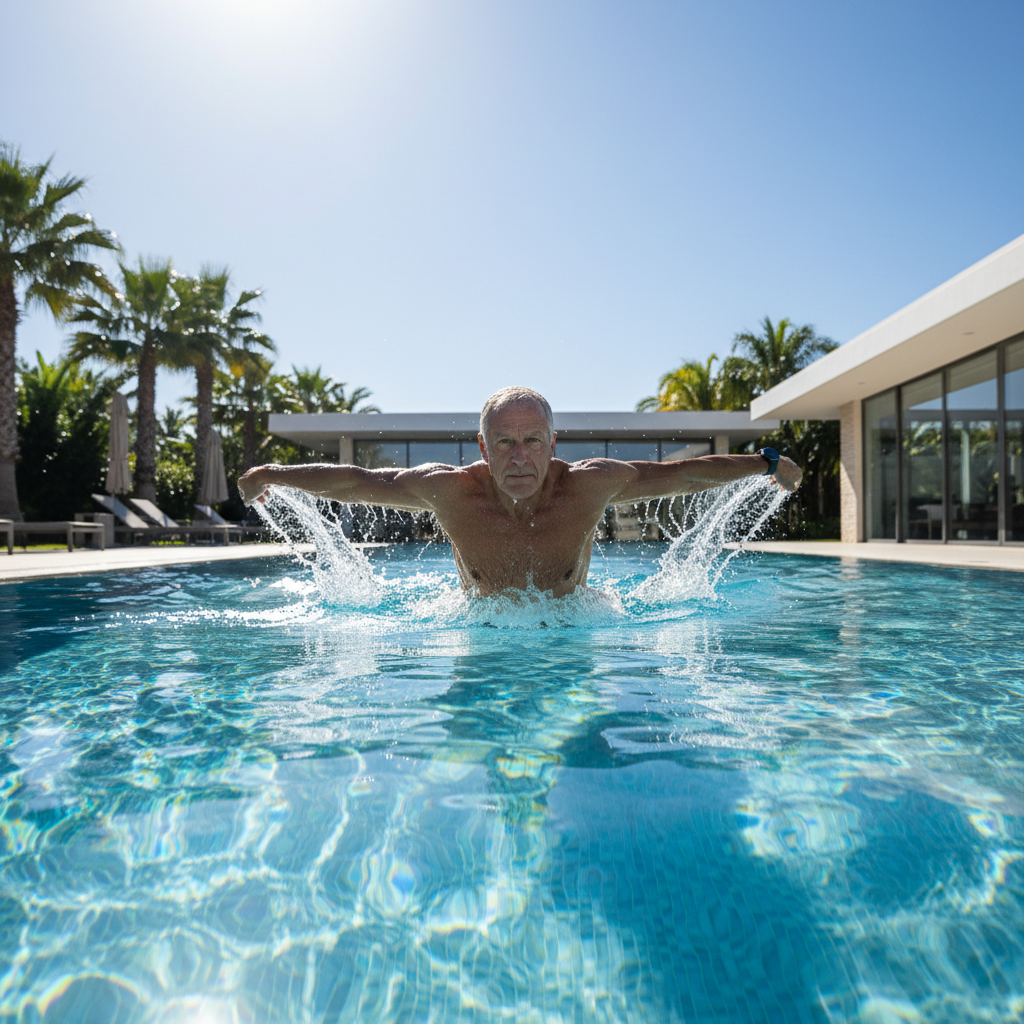
I arrive at the pool at 6:10 a.m. The parking lot is mostly empty. The chlorine smell hits me when I push through the door, and I feel something like relief. I know that sounds strange. But it's true.
I've been swimming a mile every morning for six years. I'm 73. I have osteoarthritis in both knees, a repaired rotator cuff, and a lumbar spine that my orthopedic surgeon described, memorably, as "aggressively middle-aged." On paper, I should be in pain most of the time.
In practice, I feel better at 73 than I did at 61.
How I Started
I used to run. For thirty years, through my forties, my fifties, and well into my sixties, running was my identity. Five miles before work, a half-marathon every fall, the whole lifestyle.
At 67, my knees ended that story. Bone-on-bone, both of them, and no amount of determination was going to change the physics. My doctor told me I needed to find a non-impact alternative or I'd need replacements within the decade.
I found the pool.
What Water Does
Swimming is uniquely suited to aging bodies, and the science is unambiguous about this. Water buoyancy reduces effective body weight by up to 90%, meaning joints that would scream under the impact of running operate virtually pain-free in the pool. The Arthritis Foundation specifically recommends aquatic exercise for adults with joint disease.
But it's not just about what swimming avoids. A 2020 study cited by the Centers for Disease Control found that older adults who swim regularly show significantly better cardiovascular health, improved flexibility, and markedly lower rates of depression compared to sedentary peers. That last part surprised me as much as anything.
The National Institute on Aging also points out that regular aerobic activity in older adults supports brain health and helps reduce the risk of cognitive decline. Some mornings, that feels like the most important lap I swim.
What a Mile Looks Like for Me
A mile in the pool is 36 laps in a 25-yard pool, about 50 minutes at my pace, which is slow and deliberate and absolutely unapologetic about both. I alternate freestyle and backstroke to balance muscle groups. I take 30 seconds of rest every six laps.
I have lane neighbors I've swum beside for four years without knowing their last names. We nod. We share lane space with the quiet courtesy of people who respect each other's solitude. Occasionally, after swimming, we talk in the locker room. I've learned that one man is a retired judge, another is a former school principal, and one who swims faster than all of us is 81.
What It Has Actually Changed
My resting heart rate is 58. My blood pressure runs 118/72 without medication. Six years ago I was on two blood pressure medications, and I've since eliminated both with my doctor's supervision.
My knees have not required replacement. My orthopedic surgeon is, according to himself, "cautiously astonished."
And the mental piece is real too. I solve problems in the water. The rhythm of it, the breathe, pull, kick, turn of it, quiets the part of my mind that runs anxious loops. I emerge from the pool every morning feeling, as my wife says, like a human being again.
She's not wrong.