The first computer I ever touched was a TRS-80 Model I, in the back of a Radio Shack in 1979.
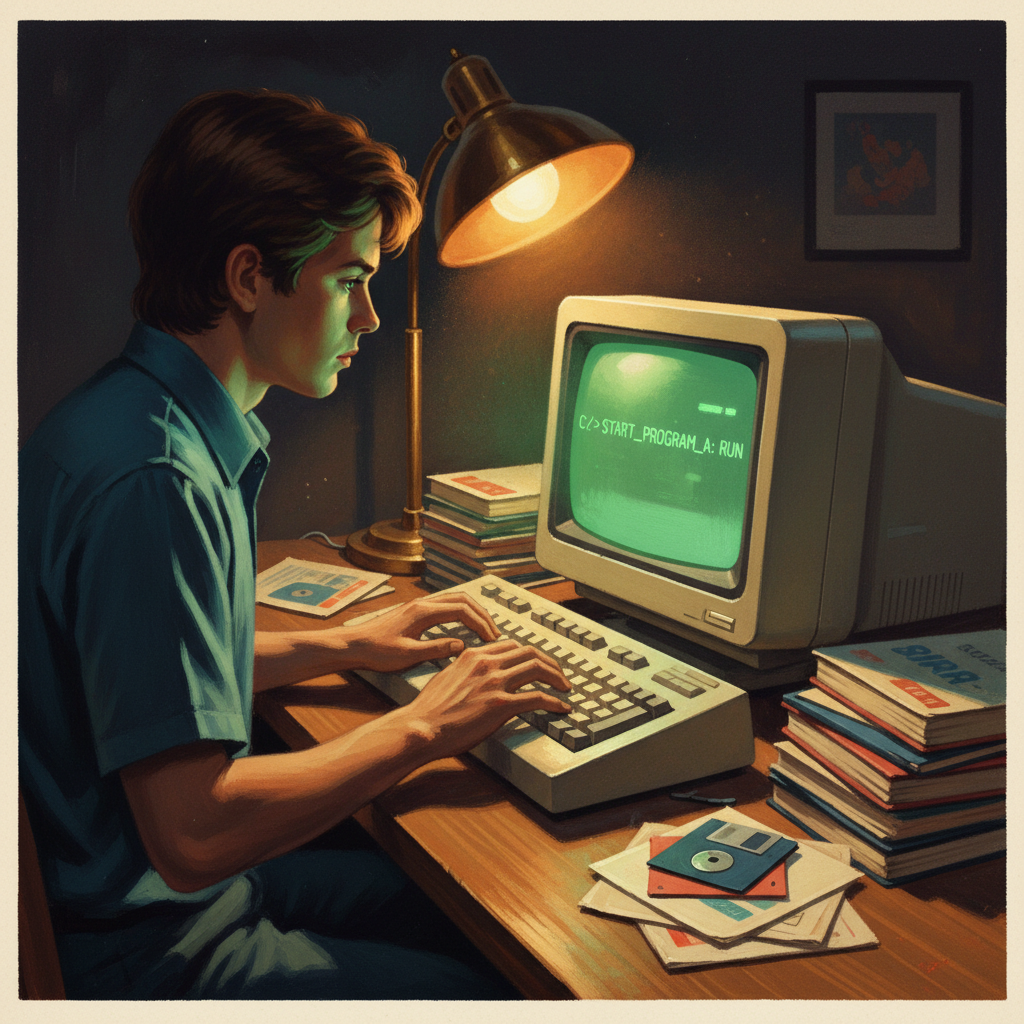
I was eleven. The store manager, a guy named Phil who wore a short-sleeved dress shirt even in winter, let me type on it for about ten minutes before my mother found me and asked what I was doing. I told her I was programming it. I had typed my name and made it print back at me in a loop. MARCUS MARCUS MARCUS MARCUS, scrolling down a green-on-black screen until Phil interrupted and asked if we were going to buy anything.
We were not going to buy anything. A TRS-80 cost around $600, which was more than my father made in two weeks.
Four years later, my parents bought a Commodore 64 for $595, and I never did another homework assignment on time for the rest of middle school.
The Machine Nobody Knew What to Do With
The personal computer did not arrive with instructions on how to change the world. It arrived with a manual, a cassette tape drive, and the suggestion that you might use it to balance your checkbook or catalog your recipes. Millions of people bought them believing those things. Almost nobody used them for that.
What people actually used them for, especially teenagers, was games and programming. Not because they were told to, but because the machines rewarded curiosity in a way that almost nothing else in the physical world did. You typed something. Something happened. You changed one word. Something different happened. The feedback loop was immediate and addictive and completely unlike anything school had ever offered.
The Computer History Museum's documentation of the personal computer revolution puts the timeline in context: the Apple II launched in 1977, the IBM PC in 1981, the Macintosh in 1984 with its famous Super Bowl commercial directed by Ridley Scott. Within a decade, the personal computer had gone from science fiction to something sitting on the desks of American families who were still not entirely sure what it was for.
The Modem, the BBS, and the First Time the World Got Small
Before the internet as we know it existed, there was the bulletin board system. A BBS.
To access a BBS, you needed a modem, a device that made an extraordinary series of sounds (anyone who was there remembers those sounds), and then connected your computer to another computer over a phone line. You could leave messages. You could read messages other people had left. You could download files, sometimes for hours, sometimes only to discover the file was corrupted or not what the description claimed.
It was, by any modern standard, completely terrible. It was also the first time most of us had ever communicated with a stranger who was not in the room. The implications of that took years to fully surface.
By the late 1980s, the precursor to the modern internet, ARPANET, originally a Department of Defense project, was being expanded into a civilian network that researchers and universities used to share information. Most of the country had no idea it existed.
Then Came the Web
In 1991, a British scientist at a physics lab in Switzerland named Tim Berners-Lee invented the World Wide Web. It is important to understand that the World Wide Web and the internet are not the same thing: the internet is the infrastructure, the pipes; the web is the system of linked documents that runs on top of it. Berners-Lee's contribution was the browser, the hyperlink, and the idea that any document could point to any other document, anywhere on the network, instantaneously.
In 1993, a team at the University of Illinois released Mosaic, the first widely available graphical web browser. It showed images. It had clickable links. It looked, for the first time, like something you could hand to a person who was not a computer scientist and have them understand within five minutes.
I remember the first time I used Mosaic. I typed in a URL, a string of characters that meant nothing to me at the time, and a page loaded with a photograph on it. A photograph. Over a phone line. Slowly, one horizontal stripe at a time, from the top of the image to the bottom, taking about forty-five seconds to fully appear.
I watched it load and understood, in a way I could feel before I could articulate, that everything was about to change.
The Dot-Com Years: When the World Lost Its Mind
By the mid-1990s, the commercial internet had arrived, and American capitalism responded the way American capitalism responds to everything: with extraordinary creative energy, massive overcorrection, and an eventual spectacular collapse.
Companies with no revenue, no product, and no business model were valued at billions of dollars. The dot-com bubble, which expanded through the late 1990s and burst in 2000, was financed in part by genuine innovation and in part by the very human tendency to believe that a new thing will fix everything that was wrong with the old thing. It didn't. What came out the other side of the crash, including Google, Amazon, and the social internet, was built on the wreckage. And it is what we live inside of now.
I was working at a startup in 1999. We had a foosball table, unlimited snacks, and a business plan that made sense only if you assumed that normal economic logic had been permanently suspended. It had not been permanently suspended. We found that out in March of 2000.
What We Actually Built
Here is what I want the people who came after us to understand: we did not know we were building the infrastructure of daily life. We thought we were making cool stuff. Some of us thought we were getting rich. A few idealists thought we were democratizing information.
All of those things were true and none of them was the whole picture.
The personal computer revolution gave ordinary people access to tools that had previously existed only for institutions. It moved the power to create, publish, and communicate from a small number of gatekeepers to anyone with a machine and a connection. The Pew Research Center's timeline of the web is a useful document for understanding how fast this happened and how much of it was improvised in real time.
We also built systems that we did not fully understand, with consequences we did not fully anticipate. The attention economy. The surveillance infrastructure. The architecture of misinformation. Those things were not in the plan. They were also not accidents. They were the logical result of systems built to capture engagement and sell advertising, without very much thought about what engagement at global scale actually does to people.
The Green Screen Never Really Goes Dark
I still have my Commodore 64. It is in a box in my garage, and every few years I take it out, hook it up to a television that is also getting old, and type my name into it.
MARCUS MARCUS MARCUS MARCUS, scrolling down a green-on-black screen, the same as it ever was.
I have been working in the technology industry for thirty years. I have shipped software used by millions of people. I have watched the thing I loved as a child become the most powerful and complicated force in human society since the printing press. And every time I look at that machine, that plastic box with its chiclet keyboard and its cartridge slot and its 64 kilobytes of RAM, I feel exactly the way I felt in the back of that Radio Shack in 1979.
Like the world is about to do something I can't quite predict, and I get to be here for it.
That feeling has never once let me down.