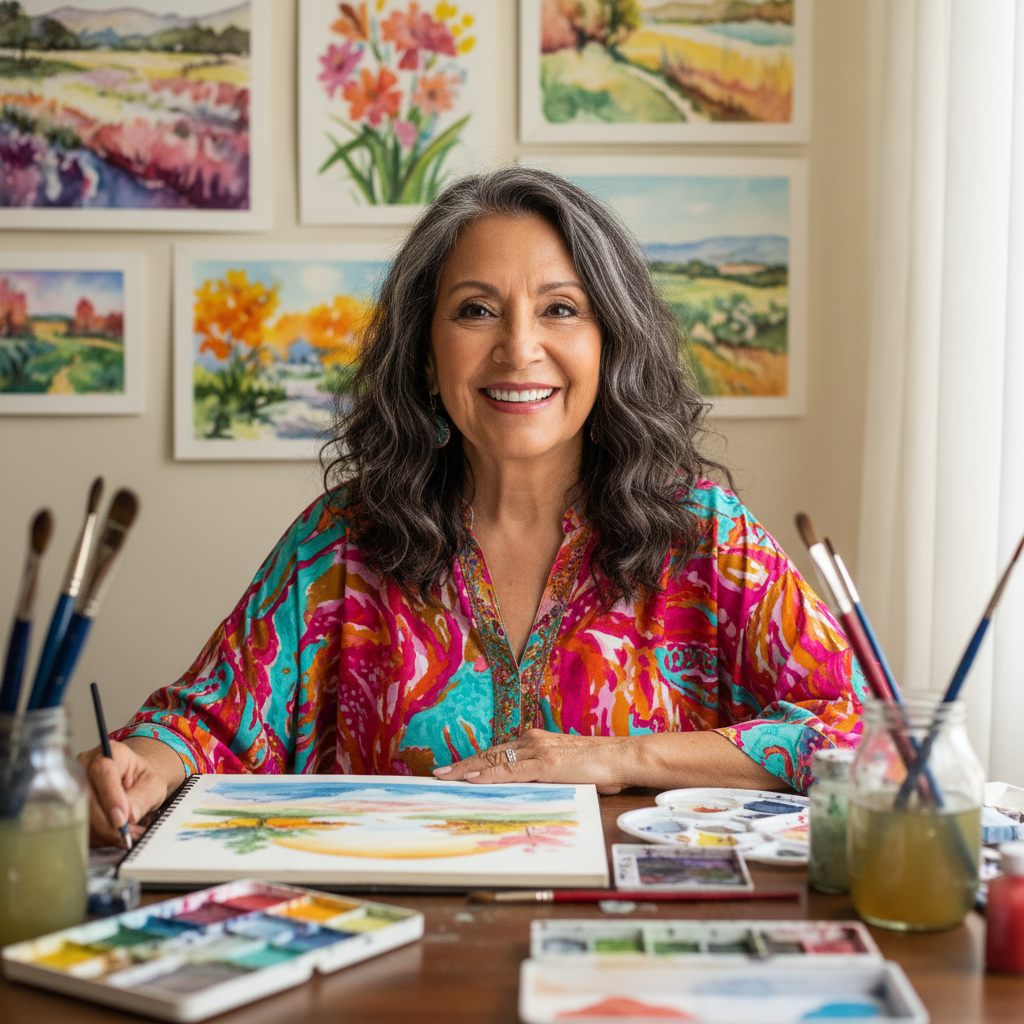
I am Rosa, and until three years ago I had never picked up a paintbrush in my adult life.
I spent 30 years as a high school counselor, listening carefully, asking the right questions, helping other people discover what they wanted. I was good at it. But somewhere in those 30 years, I never asked myself the same questions I asked my students: What do you love? What have you never tried? What are you afraid of?
The answer, it turned out, was painting.
My granddaughter Isabel handed me a small set of watercolor paints on a rainy Saturday afternoon. She was working on a school project and needed company. I mixed a pale blue with a little green and painted a shape that was supposed to be a bird. It looked nothing like a bird. I couldn't stop smiling.
What Nobody Tells You About Starting Art After 60
I've now been painting consistently for three years. I've taken workshops, joined a Thursday plein air group, and filled six sketchbooks. Here is what I wish someone had told me at the beginning:
1. Bad paintings teach you more than good ones. My first six months of work was genuinely terrible. Muddy colors, awkward shapes, flat skies. I kept every piece. Looking back at them now, I can see exactly how much I've learned, and that record of growth is one of the most motivating things I own.
2. The process matters more than the product. I had to unlearn decades of goal-oriented thinking. In counseling, everything had an outcome: a plan, a resolution, a next step. Painting taught me to be fully in the present moment. Research from the National Institute on Aging supports this: creative activities that require focused attention are associated with reduced cognitive decline and improved emotional wellbeing in older adults.
3. Community changes everything. My plein air group, eight women and two men ranging from 62 to 81, is one of the most nourishing parts of my week. We set up our easels outdoors, paint for two hours, and then talk about what we noticed. I have made real friendships there.
4. You don't need expensive supplies to start. A basic student-grade watercolor set, a pad of cold-press paper, and three brushes (a round 4, a round 8, and a flat 1-inch) will take you further than you imagine. Don't let equipment become an excuse.
5. Your perspective as an older adult is an asset, not a liability. I paint with life experience in every stroke. I know what grief looks like, what joy costs, what beauty is worth noticing. That depth doesn't come from a workshop. It comes from having lived.
The National Endowment for the Arts has documented extensively that engagement in creative activities improves quality of life, social connection, and physical health outcomes for older adults. And if you want to read more about how social connection supports healthy aging, the CDC has put together some genuinely encouraging reading on the subject.
But I didn't need a study. I needed a rainy afternoon and a granddaughter who needed company.
If you've ever thought it was too late to start something creative, whether that's painting, drawing, pottery, or collage, it isn't. I promise you it isn't. Pick up a brush. Make something terrible. Do it again.
You'll be amazed what you find on the other side of the first bad painting.